DAX: preservation and expansion of life, humanity, and consciousness.
Opening · Ouverture
Two labs and an open call.Deux labos et un appel ouvert.
The doors open soon. You can already look inside.Les portes ouvrent bientôt. Vous pouvez déjà jeter un œil.
 Opening soon · BientôtThe Sound LabLe labo du sonHeartbeats, and the language of love. Two hearts, two notes: D calls, G answers. It opens with a gift: make your own sound of love.Les battements de cœur et la langue de l’amour. Deux cœurs, deux notes : ré appelle, sol répond. Il s’ouvre sur un cadeau : crée ton propre son de l’amour.What does love sound like? → À quoi ressemble l’amour en musique ?
 Opening soon · BientôtThe Gesture LabLe labo des gestesWhat passes between people without words. Cards that move across screens. Your phone is the remote control: it sends 21 points per hand and the words it recognised. No image and no sound leave the phone.Ce qui passe entre les gens sans les mots. Des cartes qui voyagent d’un écran à l’autre. Ton téléphone est la télécommande : il envoie 21 points par main et les mots reconnus. Aucune image, aucun son ne quitte le téléphone.Step into the lab → Entrer dans le labo
 Opening soon · BientôtUniversities: join the researchUniversités et collèges : participezNonverbal, multimodal communication in learning. Open data, for everyone. We are looking for one partner site to be its home.La communication non verbale et multimodale en apprentissage. Des données ouvertes, pour tous. Nous cherchons un site partenaire pour l’accueillir.Answer the call → Répondre à l’appel
Cognition provided by Obsidian Delta, the Foundation’s first sponsor.Cognition fournie par Obsidian Delta, premier commanditaire de la Fondation.
The Gesture Lab, a first look · Le labo des gestes, un premier regard
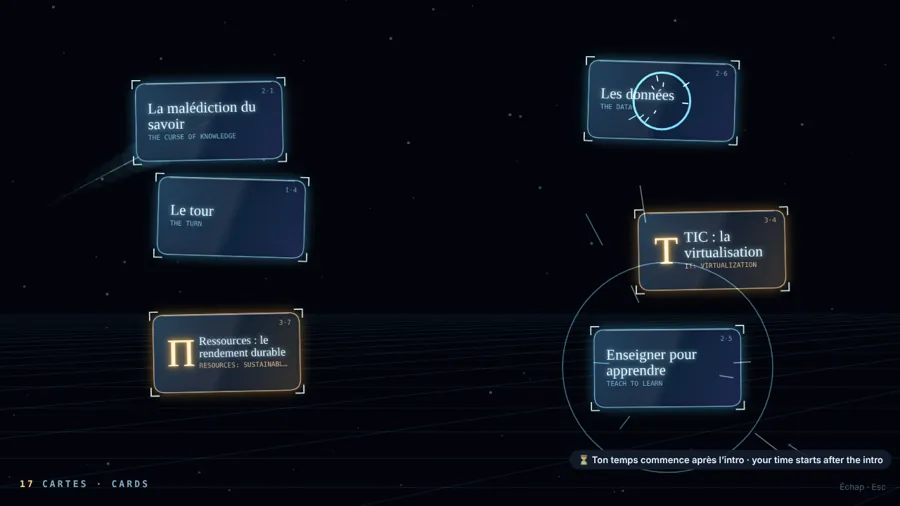
1The intro reel: the ideas fly in.L’intro : les idées arrivent. 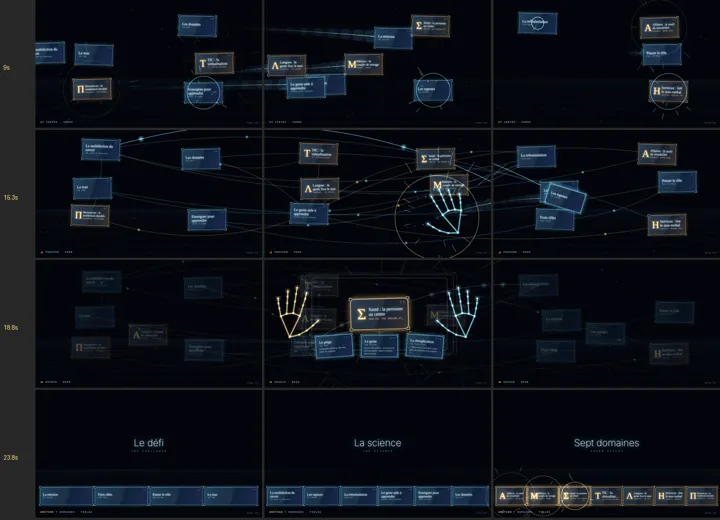
2Three screens, one wall.Trois écrans, un seul mur. 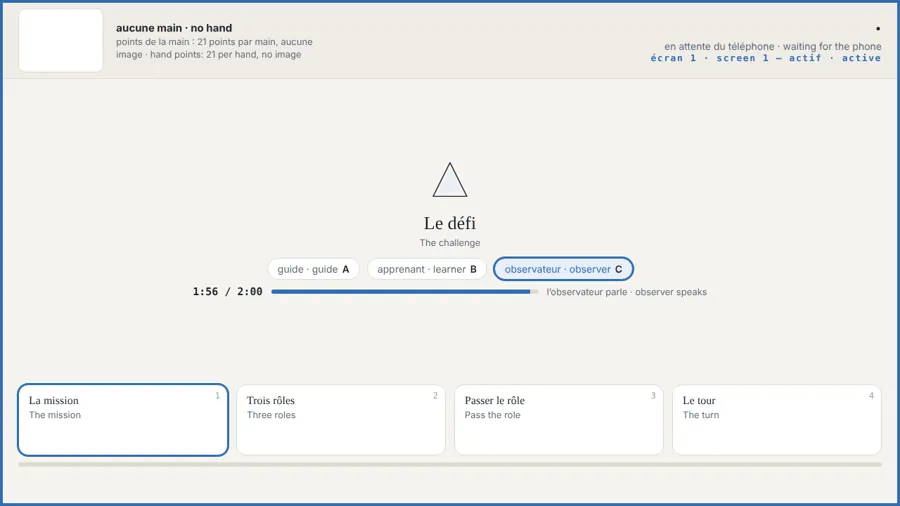
3Three roles: guide, learner, observer.Trois rôles : guide, apprenant, observateur. 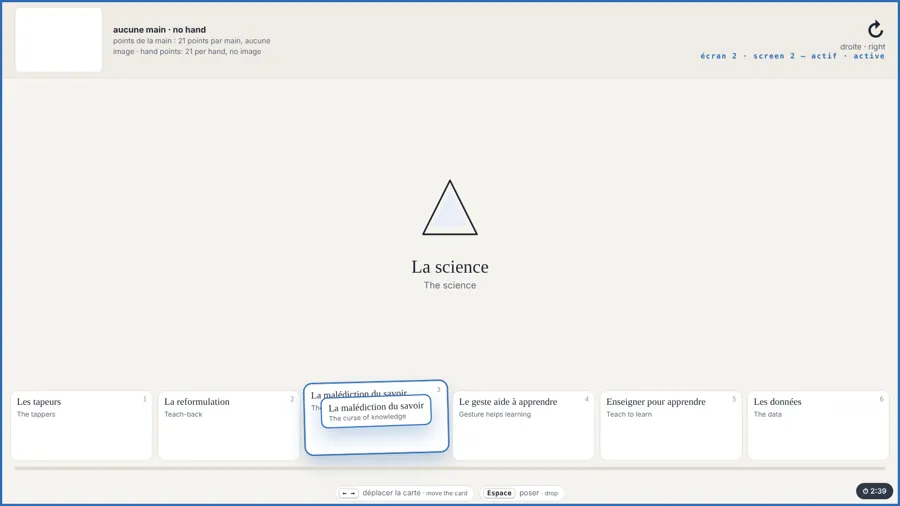
4Pick up a card, drop it where it fits.Prends une carte, pose-la où elle va. 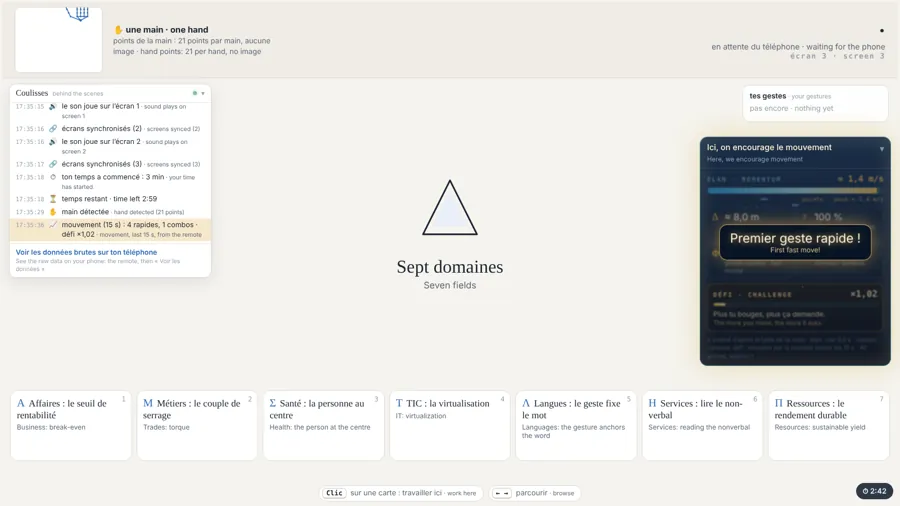
5Standing up is part of the lesson.Se lever fait partie de la leçon. 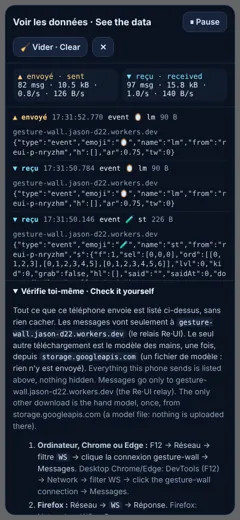
6The phone is a remote. See every message it sends.Le téléphone est une télécommande. Vois chaque message.
Your experience · Votre expérience
Pick your experience.Choisissez votre expérience.
Everything below is written for the one you pick. You can change it any time, from Your experience at the top of every page. Tout ce qui suit est écrit pour celle que vous choisissez. Vous pouvez la changer à tout moment, depuis « Your experience » en haut de chaque page.
- Give it to me straight Droit au but Plain and friendly. Simple et chaleureux.
- Just curious Simple curiosité A little more detail, still plain words. Un peu plus de détails, toujours en mots simples.
- I'm a parent Je suis parent For someone with a child at the table. Pour qui a un enfant à la table.
- I'm a guide Je suis guide For someone who teaches, tutors or trains. Pour qui enseigne, accompagne ou forme.
- I run a team Je dirige une équipe For someone responsible for other people's learning at work. Pour qui veille à l’apprentissage des autres au travail.
- I want to build on it Je veux bâtir dessus For someone who wants to make a living with it. Pour qui veut en vivre.
- I build software Je fais du logiciel For someone who ships. Pour qui livre du logiciel.
- I fund things Je finance des projets For someone deciding where money goes. Pour qui décide où va l’argent.
- I'm a researcher Je fais de la recherche For someone who wants the substrate. Pour qui veut aller au fond des choses.
- நிதானமாக, எளிய தமிழில் En tamoul In Tamil, gently. En tamoul, tout doucement.
Not sure? Start with the first one.Vous hésitez ? Commencez par la première.
Reading as Vous lisez en
Read this site as
What is the DAX Foundation?
It is one graph. Every line is the Constraint Protocol: every action recorded, accountable, signed.
Reading level — how much of the graph you see
- Nova DAX A person's record, for life. Start: What's Nova DAX? 4 questions
- Skippy DAX A cognitive companion for every citizen. Start: What's Skippy DAX? 4 questions
- The Constraint Protocol The one rule everything runs under: every action is recorded and accountable. Start: What's the Constraint Protocol? 5 questions
Meta DAX
Our initiative of universal learning. The one being built now: nine questions, written for your experience.
Universal learning: one person, one concept, for life.
English · French coming
Chapter 1 of 9Ahead · the identity linePlain and friendly
What's still missing in how we learn?
People have always had three jobs with knowledge: make it, keep it and share it. We've pretty much nailed two of them. Your phone can reach almost anything anyone knows. The job that's left is the hard one: getting the right idea into your head, one idea at a time, in a way that fits your life, for your whole life. That's what Meta DAX is for. It's a learning platform meant for everyone.
Where this goes
The best teaching there's ever been, reaching one person at a time, until it's reached everyone.
Depth 1 of 5
More
For centuries the hard part was spreading knowledge. Books were rare, then expensive, then widely available, then digital. Now a phone reaches almost everything. Keeping and spreading are no longer the problem. What was never solved is the step after: taking what exists and getting it into one specific person, at the moment they need it, in the words and the world they already live in. That is not a library problem. It is a guide-and-learner problem. The best guides certify a module once; the system makes it fit each learner; the learner keeps a record; what is shared compounds. The scope runs from the time a person can communicate for the rest of their life.
Today, and where it goes
Today a guide answers a few plain questions about a learner and what she needs to reach, and gets a set of lessons and quizzes made for that person. The guide reads it first. That is one step toward the job left. The Foundation is open about what is built and what is still an experiment.
The proof
The framing of the three jobs and the one left is published at daxfoundation.org. The 2024 prototype showed a guide answering questions and a course being made for one learner, quizzed and assessed. What is live now are the experiments for what comes next.
- Meta DAX: an introduction jeyanandan.com
- The definitions this rests on daxfoundation.org
Underneath
Every helper leaves a record. The best guides certify a module once, and the system makes it fit the next learner. The learner keeps a record of what they reached. What is shared compounds. This page is schema data, checked and signed.
The papers
Next question: Isn't this just chatting with an AI?
Chapter 2 of 9Running todayPlain and friendly
Isn't this just chatting with an AI?
Nope. A chat forgets you the moment you close it. Meta DAX keeps a record: what you've got, what you tried, and what you haven't got yet. In a chat, the instructions you type are everything. Here they're the small part. The record, a real person checking the lesson, and the checks along the way are the rest.
Where this goes
Because it remembers you, the help keeps getting better over your whole life instead of starting over every time.
Depth 1 of 5
More
Open a chat window, ask a question, get a good answer. Close the tab and it forgets you completely. Next time you start from zero. That is a chat. A record is different. It keeps what you reached, what you tried, and where it went nowhere. The chat is the hands and ears: the way the learner talks and listens today. The record is the body: the thing that keeps going after the chat closes. Meta DAX is built on the record, not the chat. The guide is the human in the loop: she reads the record, edits what the learner gets, and decides what comes next. Today's packages are made from open meta prompts, on purpose, so the guide can use any AI on her own account, free.
Today, and where it goes
Today a guide answers a short set of questions about a learner and what she needs to reach. Open meta prompts run on the guide's own account and produce lessons, quizzes and follow-up questions. The guide reads and edits before anything reaches the learner. What gets saved is the record: what the learner reached, what she tried, what she did not yet. That record is what the next session starts from, not zero.
The proof
Sample packages and the open repository are public. The record lives in the learner's own repository; git is the database. The meta prompts are open, free, and work on any model.
- Sample packages and showcases, each made from a short set of prompts daxfoundation.org
- The open repository: git is the database, records live in the learner's own repository github.com/daxfoundation/metadax
Underneath
The record schema is the substrate. Every package is schema-validated data, not markup. The guide's edit is a step in the pipeline, not optional. The open prompts on the guide's own account mean no lock-in: any model, any time.
The papers
Next question: Has anyone built this before?
Chapter 3 of 9Done · 2024Plain and friendly
Has anyone built this before?
- The 2024 prototype: fractions for an eleven-year-old, taught through baseball youtube.com, DAX Foundation
- The real five-deep follow-up chain from 2024, and what Meta DAX changes github.com/daxfoundation/metadax README
Yep. Back in 2024, a working app built a whole course for one person, from where she started all the way to her goal. It quizzed her as she went and showed her exactly where she stood. There's a video of it. It worked, again and again. What you see on this site now are experiments to fill in what that app was missing. They're experiments, not a finished product.
Where this goes
What already worked for one person gets to everyone. The open questions are about reaching people, not about whether it works.
Depth 1 of 5
More
They ran it simulation after simulation. A learner's goal went in; a full curriculum came out, matched to that learner. The quizzes ran through Bloom's levels — recall, understand, apply, analyse — and told the learner exactly where they stood. It worked. The question that surfaced was not whether it could generate. It was: can it remember across sessions? Can a guide who is a step ahead of this learner shape it? Can someone with five minutes a day and limited connectivity actually use it? Those are the open experiments. They are not a product. Where the work wants to go and where it is today must never be confused.
Today, and where it goes
What you can see today is the video: the 2024 prototype running, generating a full individualized curriculum end to end. The public experiments now tackle the record that remembers, reuse by meaning rather than browsing, and guides in the loop. Five minutes a day is the access floor the experiments are designed around. Each experiment is open; none is a finished product.
The proof
The 2024 prototype is documented and the video is public. The guide is a person a step ahead of this learner; the learner is whoever is reaching. The experiments address what the prototype left open.
- The 2024 prototype: fractions for an eleven-year-old, taught through baseball youtube.com, DAX Foundation
- The real five-deep follow-up chain from 2024, and what Meta DAX changes github.com/daxfoundation/metadax README
Underneath
The prototype showed that generation works. It did not solve the record, the meaning-based reuse, or the guide's role in the loop. Those are the experiments. The Foundation keeps where we are and where we want to go as two distinct things. This page is schema data, checked and signed.
The papers
Next question: What if you had thirty helpers?
Chapter 4 of 9ResearchedPlain and friendly
What if you had thirty helpers?
In a normal classroom, one teacher splits her attention between thirty students. Meta DAX flips that around: thirty helpers focus on one person, right when they need it. The teacher's still in charge. She sends the helpers and tells them what to do, while she keeps teaching.
Where this goes
Thirty helpers for every learner, thirty for every teacher, and the teacher's attention back on what only a person can do.
Depth 1 of 5
More
Think of a child stuck on fractions on a Tuesday. Today she waits her turn. Here, the teacher can send thirty kinds of help to her while the lesson goes on. One explains it another way. One finds the example that fits her. One remembers what she got wrong last week. One tells her mum tonight what to ask about at dinner. The thirty are not people, and they are not always the same thirty: a different set turns up for a first week at a bakery than for fractions. Over a whole life, that is thousands of helpers who have each, for a moment, been working out how to help this one person. And it goes both ways. The teacher gets thirty of her own.
Today, and where it goes
Right now this is a package, not a building. A guide, which means a teacher, a parent, anyone a step ahead on this one thing, answers a few plain questions, and out comes a set of lessons made for one learner, with the quizzes and the follow-up questions built in. The guide reads it first. It is made to work on five minutes of internet a day, because that is the hardest case, and because everybody has to be able to have it. The part no helper can do stays with the guide: noticing this child, today, and deciding what she needs. The helpers are only ever as good as the person sending them. Where this goes: the helpers stay connected all day, one idea at a time, the moment it is needed, and the guide spends her attention on what only she can do.
The proof
We built this once before, in 2024. The video shows a whole course made for one learner: taught, quizzed, and marked. What is public now are the experiments for the next part, not a finished product.
- The 2024 prototype, on video DAX Foundation on YouTube
- What it did in 2024, and what Meta DAX changes github.com/daxfoundation/metadax
- Human delta value, the measure under it daxfoundation.org
- Guide, learner, a step ahead: the definitions daxfoundation.org
- The Constraint Protocol, at the DAX Foundation daxfoundation.org
Underneath
Every helper leaves a record of what it did and why. If a helper gets something wrong, we can find out how, and make sure it does not happen again. That record is called the Constraint Protocol, and it sits under everything the Foundation does. What one child's helpers learn is shared, so the next child's helpers start further ahead. Even this page works that way: the words are data, checked and signed, and the page draws them.
The papers
Next question: So what's left for people to do?
Chapter 5 of 9Running todayPlain and friendly
So what's left for people to do?
Noticing you, right now, and figuring out what you need. No helper can do that. Your guide is just whoever's a step ahead of you on this one thing. Everybody's a learner, and who leads keeps switching. The helpers make your guide stronger, but they're only as good as she is.
Where this goes
Every guide is free to do the part only a person can do, for every learner, at a scale no school could ever afford.
Depth 1 of 5
More
Two climbers share the lead. One moves ahead, places an anchor, waits. Then the other takes the front. The guide is only the guide on this one pitch; lower down she is the learner. Meta DAX uses these two words, guide and learner, for every pair, whether it is a kitchen table, a classroom or a company onboarding a new hire. The helpers do the explaining, the remembering, the follow-up. But the guide is the one who can see the learner. Human delta value is what the guide brings that the helpers cannot: she notices this learner, at this juncture, and judges what she needs. The helpers are only as good as the guide sending them. As cognition is handed back to the guide she gets to spend it on what only she can do.
Today, and where it goes
Today a guide answers a few plain questions about a learner and what she needs to reach, and gets a package of lessons, quizzes and follow-up questions made for that learner. The guide reads it first. The package works on five minutes of connectivity a day. The loop that matters is the guide's: observe this learner, at this juncture, decide. That loop is not automated, because it cannot be. A cognitive companion is only as good as its human.
The proof
The definitions of guide, learner, and a step ahead are public at the Foundation. The 2024 prototype showed the full loop: a guide answered questions, lessons were made for one learner, quizzed and marked. What is live now are the experiments for what comes next.
- Guide, learner, a step ahead, reach daxfoundation.org
- Five chairs: parent, tutor, teacher, trainer, researcher daxfoundation.org
Underneath
The Constraint Protocol records every helper action under the guide's authority. When a helper gets it wrong the record shows how. That is what lets a guide trust the helpers at all. What one guide's learner teaches the system is shared, so the next guide starts further ahead. Every edition of this page is schema-checked and signed.
The papers
Next question: What does it keep track of?
Chapter 6 of 9Running todayPlain and friendly
What does it keep track of?
What you've learned, what you tried that didn't work out, who helped you, and what other people picked up from your work. The dead ends get saved just as carefully as the wins. The record is yours. It stays private unless you decide to share it, and it goes wherever you go.
Where this goes
Your record stays yours for life. It grows into Nova DAX, and one day a companion of your own reads it with you.
Depth 1 of 5
More
A system that hid your dead ends would be steering you without telling you. So the record keeps them. What you tried and where it went nowhere sits alongside what you reached. Who guided you — which person was a step ahead on that thing, at that moment — is there too. Reuse works by meaning: if another learner made something that means what you need, the system can find it, not because you browsed for it but because the meaning matches. Your record lives in your own place, not on a platform's server. A guide and a companion can read what you let them read. Published for good only if you choose.
Today, and where it goes
Today the record is the spine of every package: reached, tried, guided, reused. What is being built next is the always-on layer that keeps the record between sessions, so a guide picks up exactly where you left off. Every entry is signed under the Constraint Protocol. The record you build now is the first slice of Nova DAX.
The proof
The record schema and the append-only files in the learner's own repository are public at the Foundation. Sample packages show the format in practice. The Constraint Protocol defines how every entry is signed.
- How records are kept: append-only files in the learner's own repository github.com/daxfoundation/metadax
- Sample packages, each with the prompts that made it daxfoundation.org
Underneath
Reuse by meaning is the open experiment: finding another learner's asset by what it represents, not by browsing a catalogue. The Constraint Protocol is the signing layer: every entry is traceable to the guide and the moment. The seed of Nova DAX is a design commitment: nothing in this record will be locked into a platform you cannot leave.
The papers
Next question: What if you only get five minutes online a day?
Chapter 7 of 9ResearchedPlain and friendly
What if you only get five minutes online a day?
Right now it works with just five minutes of internet a day. That's the toughest situation, and we picked it on purpose, because everyone needs to be able to use this. Where it's headed is help that's always there, the moment you need it. Five minutes is where it starts, not where it ends.
Where this goes
Help that's always there, one idea at a time, on any connection.
Depth 1 of 5
More
A package is made for one learner, by a guide. It works offline. Five minutes of connection is enough to get it and send back a record. The guide can reach any learner, anywhere, at any bandwidth. That is the floor. Today's packages simulate the once-a-day case. That is the start, not the finished shape. Where it goes is always-on: a companion that is there at every moment, knowing this learner, with helpers that change with the moment. The benchmark holds either way: everyone must have access, and we build for all bandwidths.
Today, and where it goes
Today a guide answers a few questions about a learner and what she needs to reach. A package is made: lessons, quizzes, follow-up questions. It works on five minutes of internet. The learner works through it offline. The record comes back. That loop is running now. The always-on layer is the next experiment.
The proof
The five-minute package loop is documented at the Foundation. The 2024 prototype showed a full package made for one learner, quizzed and marked. The definitions of the companion, the benchmark, and all bandwidths are public.
- What the five-minute bundle looks like today daxfoundation.org
- The cognitive companion: the hands and ears of the whole system daxfoundation.org
Underneath
Every helper action is recorded under the Constraint Protocol, so the guide can see what happened and why. That record is what lets the system work at any bandwidth: the connection is brief, but the accountability is complete. The platform is schema-first; every edition is checked and signed.
The papers
Next question: What can I try right now?
Chapter 8 of 9Running todayPlain and friendly
What can I try right now?
Experiments, not a finished product. There are five ways in: one each for parents, tutors, teachers, trainers and researchers. Anyone can walk in and try one without help. It's all free and open, and anything useful gets shared as soon as it's made.
Where this goes
People build it together, out in the open, and everything useful gets shared as it's made.
Depth 1 of 5
More
Nothing in the architecture is fixed. What is ready is published as it is made: sample packages, showcases, the definitions, the writing. You can try a package, send a scenario, or support the Foundation. The five doors are for the five guide roles; walk through the one that fits you and you see what is there for a guide in that role. The showcases are made by the platform from plain prompts — a few words in, a working thing out. More layers are being built. None of it is indicative of a final product; it is here so the initiative is useful to people from the very start.
Today, and where it goes
Pick your door. A parent's door opens on what a parent would use. A researcher's door opens on the evidence and the schema. Try a sample package to see what the platform makes. Send a scenario if you have a learning situation you want the platform to look at. Everything usable is free, open source, and there now.
The proof
The samples and showcases are live at the Foundation's site, published as they are made. The open repository is public. These are experiments; nothing is called a finished product.
- The samples and showcases, as of today daxfoundation.org
- The showcases, in 3D daxfoundation.org
- The open repository github.com/daxfoundation/metadax
Underneath
Open source means the code and the schema are public. Free means no paywall for any learner or guide. The samples are what real packages look like. The showcases show what the platform generates from a few plain prompts. A citizen's own companion — an always-on guide for one person — is the next layer, not yet built.
The papers
Next question: Why does all this matter?
Chapter 9 of 9AheadPlain and friendly
Why does all this matter?
Anyone who can communicate can learn anything, for life, from the best teachers out there, in their own language and their own situation, on any internet connection. That's what all of this is for: to help every person be their best, and to protect life, people and minds and help them grow.
Where this goes
Every person at their best, and life, people and minds protected and growing.
Depth 1 of 5
More
Five chapters back, the question was: what is the job left? Getting knowledge into one person at a time, in their context, for a whole life. This chapter is what happens when that job is done. The best guides certify a module once; the system makes it fit the next learner; the learner keeps a record for life. Guides teach what only a guide can teach, at a scale no school could afford before. The record is yours: portable, private by default, the seed of Nova DAX. The companion reads it with you. And what is shared compounds: every learner who starts after you starts further ahead, because you were here.
Today, and where it goes
What exists today is the first step: a package made for one learner, on five minutes of connectivity, a guide in the loop, a record signed. The next steps are the always-on layer, the record carried across sessions, the companion. What makes this possible is the experiment being run in the open: everything usable published as it is made, the planned experiments as where we want to get to.
The proof
The 2024 prototype showed the full loop end to end: a guide answered questions, a package was made for one learner, quizzed and assessed. The samples and showcases are live at the Foundation. The definitions, the Constraint Protocol, the schema are public. These are experiments; the Foundation says so plainly.
- The definitions this rests on daxfoundation.org
- The Constraint Protocol: the accountability substrate daxfoundation.org
Underneath
The canon for this chapter is the Foundation-wide canon: eight statements of what this makes possible, from the why to the constraint. A way, never the way. The fit to each person is a strength, not a feature. Dead ends are kept. The record is the learner's for life. Every public interaction makes the next person's start further ahead.
The papers
Go further
Meta DAX
The Meta DAX hub. Pick your chair:
See it: the same recipe built each of these.
- Systèmes de fichiers imbriquésVirtualized storage in Proxmox VE, written in French for networking students: six 3D scenes, a configuration simulation and a bilingual lexicon.
- Words into AlgebraA tutor's kit for turning sentences into equations: five interactive 3D scenes, three routes for the time you have, and a pause before every example.
- One dish, its storyA Jaffna curry in a 3D kitchen, Tamil & English, read by someone from the community.
- The Year on the WallA whole Grade 6 science year from one brief: 36 weeks mapped, misconceptions named, one week built in full.
- The Proton MillA 3D Biology 101 lesson on how mitochondria make ATP, with instructor notes.
- The Tutor's DeskOne tutor's week: rough notes, a parent-ready report, and the guide coach on a real problem.
- First Week at the BakeryA staff onboarding module made from a one-page brief.
- Le Stade des FractionsFrench fractions in a 3D stadium.
- A sample tutor reportwhat a tutor gets back
Make your first lesson (about ten minutes) →
The first thing the recipe built, in September: the Newton’s laws run report (report; simulated learner).
MetaDAX is free. It is built on paid compute. If it helped, a coffee on Ko-fi or a GitHub sponsorship keeps it going.
Publications: For parents and tutors · Five parts · Five short pieces for a parent at the kitchen table, each pointing at a page that already exists.
The research
The short version: we try small things first and share every result, including the ones that didn’t work out.
In the run above: “Has anyone built this before?” ↑
The benchmark — a person who can communicate to a master’s on five minutes a day — is audacious on purpose. We are developing this for all bandwidths! It rests on fourteen small experiments first, then the twelve scenes and X13 and X14. Twenty-four of the twenty-eight have now run, with models or scripts and never with a person, and several came back negative. The small ones are how we earn the big ones.
- The research, the measure and the experiments →
- The X13 / X14 findings
- The 18–19 October findings
- In the run above: “Has anyone built this before?” ↑
Publications: What has run · Five parts · What has actually been run, with every number labelled.
Constraint Protocol
The ground everything here stands on.
One simple rule under everything: write it down, know who’s responsible, and sign it.
The short, friendly version: five questions →
A way for parties — people, companies or software — to declare in advance what they will not do, and then be checked against it. It keeps a signed record nobody can quietly edit, keeps witnessing and judging separate, and lets anyone dispute any record. DAX is one constraint built on it, and Meta DAX is meant to run on it; its protocol fields are reserved and empty today. The aim is that what one person works out compounds for everyone after them. A public working draft, run in full once so far.
- The guided version: five questions, written for your experience →
- The Constraint Protocol, honestly: where v0.5 stands →
- What that looks like, scene by scene
- The specification — CP-SPEC v0.5
- Why it matters: The Constraint
Publications: Accountability: the Constraint Protocol · Five parts · A record, not a wall: what a declared constraint is and what one run of it showed.
A note from the founder
I have been at this since I was 23. I am now 49.
“This” has only ever been one thing: the right information, to the right person, at the right time. I found it the day I left university for the last time, and everything I have built since has been a draft of it. Meta DAX is the current one: the latest expansion of the same purpose, and the first where the information is the kind that lets a person go and get all the rest.
It has taken a tremendous amount of personal sacrifice, on every level, and it still does. All of it has come out of my own pocket.
If you want to know why it means this much to me, it is here. I was the kid it did not exist for.
On the way to getting Meta DAX out, while working out how knowledge and intelligence could be made to compound, it became clear that I needed something else first: an accountability framework. A flight recorder, the black box the aviation industry keeps, for the thing I could see coming. I set that out in The Constraint. They are not two separate fights. The rubbish on the beach is a real problem, and so is the thousand-foot wave coming towards it, and you do not get to pick one. But while that work was in front of me I did not have the cognitive capacity to give Meta DAX what it needed, and I put it off from the beginning of this year. It is my purpose, and as of 28 September it is in the open: the experiments, every result, and what comes next.
So, being completely transparent: if you would like to buy me a coffee, it would mean a great deal to me, from the bottom of my heart. Thank you. It goes to me personally, not the Foundation and not the company.
Who is behind this: about the Foundation →
Newest outside a series: What twenty-nine runs say about the design, Twenty-nine runs in two days, and what failed.
The long-form work behind all of this, by Jason Jeyanandan, who set this Foundation up: Meta DAX: An Introduction, The Constraint, and Fuckery, published in full with its dead ends left in.
↑ Pick your experience and the page opens.Choisissez votre expérience et la page s’ouvre.